See how digital payment tokens are really being used for payments
Welcome to the Stablecoin Retail Payments Index
Most on-chain tokenised payment volume comes from trading and liquidity flows. The Digital Retail Payments Index filters these out to highlight everyday transactions - payroll, supplier transfers, and eCommerce payments under $10k.
Orbital’s Index provides a clearer picture of how digital payment tokens are being used for real payments across regions, networks, and tokens. Built in partnership with Artemis and Sensor Tower, it delivers a data-driven view that cuts through trading noise and shows genuine retail-scale adoption.
Subscribe for quarterly Index updates direct to your inbox
Data
Highlights
Highlights in Figures
As of January 2026
$306b
Circulating supply
$20.4tn
Annualised W2W volume
375m
Monthly retail payments
50m
Daily active wallets
49.6m
Stablecoin addresses
€67.2b
Annualised EUR volume
Latest insights
Market Snapshot
Third edition: Q4 2025
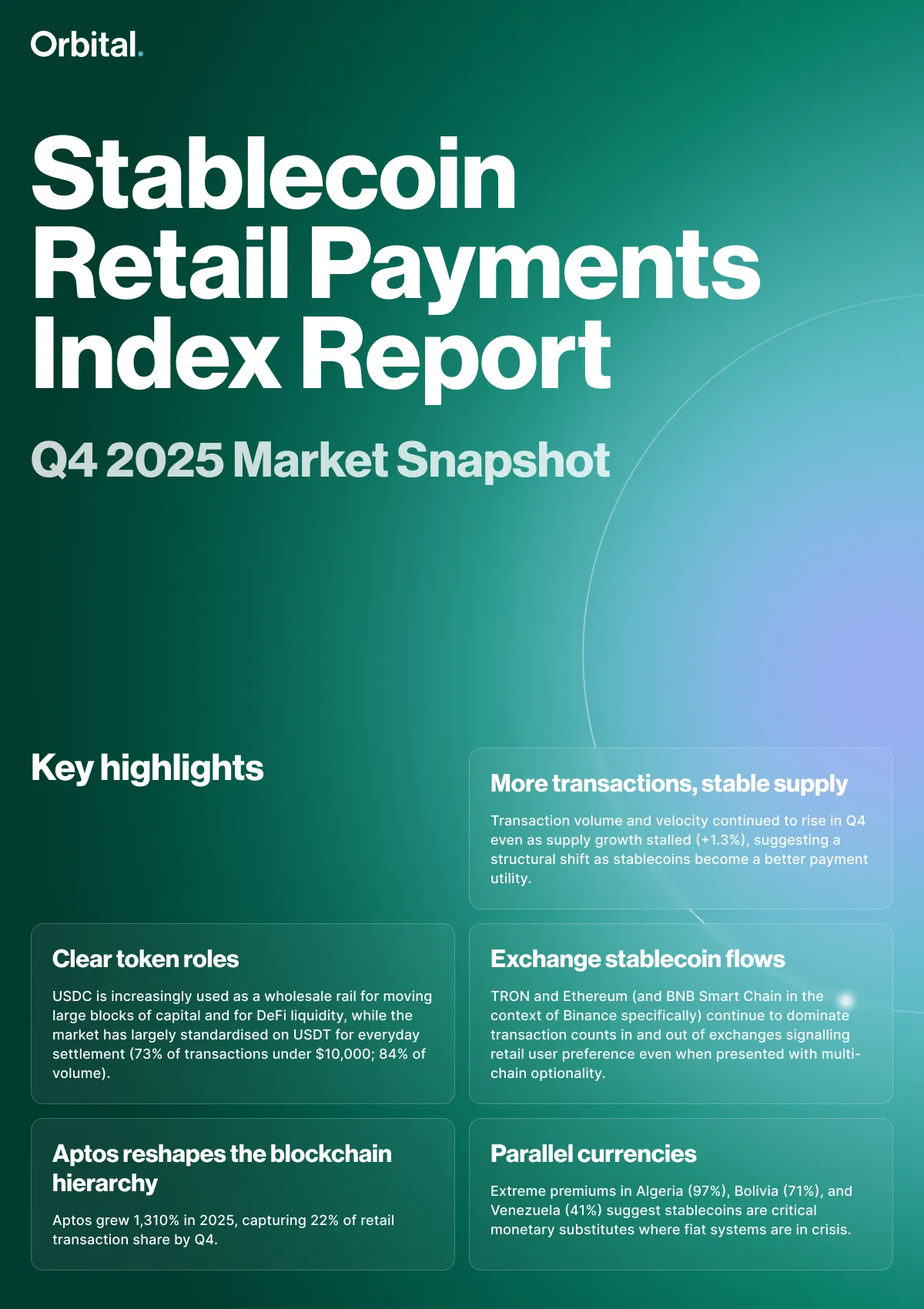
Orbital's third edition of the Digital Assets Retails Payments Index delivers fresh Q4 insights. This snapshot captures both the culmination of a fluctuating year and a structural inflection point. It also includes a new section exploring exchange stablecoin flows, which reinforces the emerging specialisation of stablecoins.
Further, the snapshot looks back to how digital assets we reused across 2025 and what this may imply for 2026 . Future reports will continue to include new and evolving trends, with the introduction of a deep dive on a stand out trend.
Our unique methodology is aimed to filter for consumer-scale payments (transactions under $10,000) and removes non-payment related activity. Filtering helps isolate digital payment tokens activity that more closely resembles peer-to-peer payments, remittances, merchant payments, payroll and SME transfers, not speculative trading.
Blockchain data for the Index is sourced in partnership with Artemis.xyz, a leading provider of on-chain blockchain analytics. Combined with data provided by Sensor Tower’s off-chain insights on wallet, exchange, and payment app usage, the Index uniquely links on-chain transactions with real-world customer behaviour across regions and use cases.

Important: The views and information shared here are for general informational purposes only and do not constitute financial, investment, legal, or other professional advice. No representations or warranties are made as to the accuracy, reliability, completeness, or timeliness of the data or content provided. The analysis is based on publicly available blockchain and third-party data, subject to known limitations, assumptions, and estimation methods including but not limited as outlined in the Methodology & Limitations section. Readers should conduct their own due diligence and consult with a qualified advisor before making any financial decisions. Mentions of specific digital assets, protocols, or platforms are for analytical purposes only and do not constitute endorsements or evaluations of their quality, stability, legality, or regulatory status. Orbital does not recommend buying, selling, or holding any particular digital asset and makes no representations regarding the suitability of any such asset for any use.
Methodology & Limitations: This Index is based on analysis of public blockchain transaction data. Our methodology includes filters designed to isolate smaller, wallet-to-wallet transfers under $10,000, which we use as a proxy for “retail” or consumer-scale payments. This threshold is an analytical assumption; while it helps remove larger institutional or speculative trades, it does not guarantee that all included transactions are truly consumer payments. Similarly, wallet activity is inferred using best-effort heuristics, which may result in some misclassification. Blockchain data is inherently pseudonymous and incomplete. This report does not capture off-chain transactions or private transfers, and should be considered directional rather than comprehensive.