.svg)
.svg)

.svg)
Retail stablecoin payments surged in 2025. What the data signals for businesses exploring stablecoin payment strategy, infrastructure, and adoption.
Stablecoins are increasingly discussed as part of modern payment infrastructure, but the key question for many businesses is no longer what are stablecoins? It is how are they actually being used in real payment environments?
Orbital’s Q4 Stablecoin Retail Payments Index provides a data-driven view into retail-sized transactions under $10,000. Rather than focusing on speculative flows or total supply growth, the Index isolates consumer-scale activity to understand how stablecoins function as everyday payment rails.
The trends observed across 2025 point to a broader shift: stablecoins are behaving less like passive crypto assets and more like operational payment infrastructure.
Stablecoins are acting more like payment rails than investment instruments
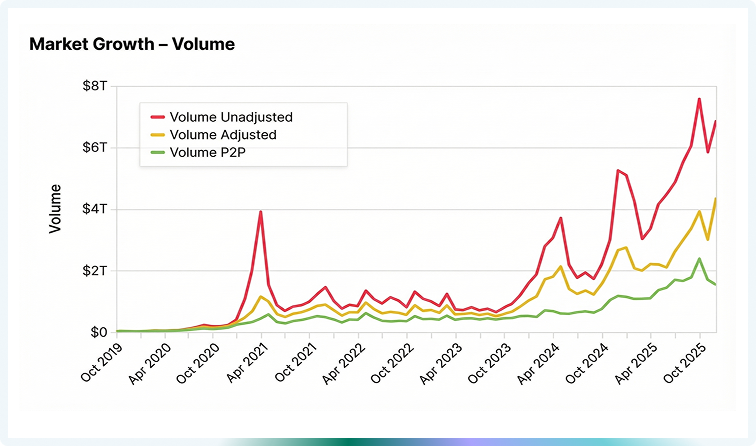
One of the clearest signals from the data is the divergence between supply growth and transaction activity. While supply growth slowed significantly in Q4, transaction volumes and velocity continued to rise.
This matters because it suggests increasing utility. Each dollar of circulating supply supported more payment activity over time - a pattern consistent with infrastructure maturing beyond speculative cycles.
For businesses exploring stablecoin payment strategy, this suggests that retail usage is not purely event-driven. Transaction behaviour appears increasingly embedded in day-to-day payment flows.
Token roles are diverging
The data also highlights functional segmentation across stablecoins.
Retail-sized transfers are heavily concentrated in USDT, reinforcing its position as a default settlement asset in many consumer and emerging market corridors. USDC, by contrast, shows stronger representation in higher-value and programmatic flows, suggesting a more institutional orientation.
Rather than competing as interchangeable instruments, stablecoins appear to be evolving into differentiated rails with distinct usage profiles.
For businesses evaluating stablecoin payments, this divergence signals that token selection may be influenced by corridor, counterparty type, and liquidity environment, not simply market share.
Exchange infrastructure is influencing real-world payments
A significant portion of observed retail payment flows originate from exchange-linked accounts rather than self-hosted wallets.
This is an important structural insight. In practice, exchange withdrawal defaults, routing incentives, and supported networks materially influence which blockchains and tokens dominate real-world merchant payments.
For businesses exploring stablecoin payment acceptance, this suggests that infrastructure decisions cannot be made solely on theoretical network preferences. Exchange behaviour increasingly shapes retail liquidity and transaction routing.
Blockchain preferences are shifting rapidly
2025 saw notable redistribution of network share across retail stablecoin transfers. Some chains gained significant share through organic growth, while others saw volatility or relative contraction.
This reinforces a broader point: blockchain hierarchy is not static. Fee dynamics, exchange alignment, ecosystem incentives, and user behaviour can reshape payment flows within relatively short timeframes.
For infrastructure teams, this highlights the importance of flexibility. Supporting stablecoin payments increasingly means accommodating multi-chain environments rather than relying on a single dominant network.
Stablecoins as parallel economic rails
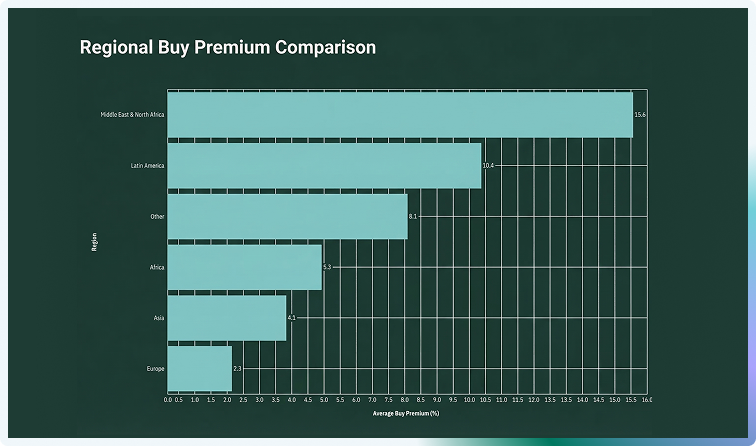
Geographic premium analysis suggests that in certain distressed economies, stablecoins are functioning as de facto parallel currencies rather than optional settlement tools.
Persistently elevated premiums in specific markets indicate that stablecoins may serve as alternative monetary infrastructure where local currency volatility or capital constraints limit access to USD liquidity.
For businesses operating in cross-border corridors, this underscores how stablecoin usage can vary materially by region - from efficiency tool in developed markets to economic substitute in others.
What this signals for stablecoin payment strategy
Taken together, the data points to several structural shifts relevant to businesses exploring stablecoin payments:
- Retail stablecoin activity is increasingly shaped by exchange infrastructure and routing behaviour.
- Stablecoins are diverging into distinct functional roles across retail and institutional use cases.
- Transaction growth outpacing supply growth suggests a move toward utility-driven adoption.
- Blockchain preference is fluid, reinforcing the importance of adaptable infrastructure.
- Regional demand dynamics can materially influence how stablecoins function in practice.
Infrastructure design matters more than access
As adoption expands, the challenge for businesses is often less about accessing stablecoins and more about operating them reliably across fragmented infrastructure.
Multi-chain environments, exchange-driven liquidity, regulatory considerations, and cross-border settlement requirements all influence how stablecoin payments behave in production.
Orbital’s focus is on connecting stablecoin and traditional payment rails within a unified operational framework, supporting businesses to adapt to evolving payment flows without stitching together disjointed providers.
Looking ahead
By the end of 2025, transaction activity had reached a new elevated baseline, while daily active users appeared to stabilise near current capacity levels. Whether the next phase of growth is driven by regulatory clarity, geographic expansion, or breakthrough commercial use cases remains to be seen.
What is clear is that stablecoins are increasingly functioning as payment infrastructure. For businesses exploring stablecoin payment strategy, understanding real transaction behaviour - rather than headline supply figures - is becoming central to informed decision-making.
The full Q4 Stablecoin Retail Payments Index explores these dynamics in greater depth, including token, blockchain, exchange, and geographic analysis across 2025.
Explore the data
View the live dashboards for the latest stablecoin retail payments trends, or download the latest Snapshot Report for the full analysis.
Disclaimer - Important: The views and information shared here are for general informational purposes only and do not constitute financial, investment, legal, or other professional advice. No representations or warranties are made as to the accuracy, reliability, completeness, or timeliness of the data or content provided. The analysis is based on publicly available blockchain and third-party data, subject to known limitations, assumptions, and estimation methods including but not limited as outlined in the Methodology & Limitations section. Readers should conduct their own due diligence and consult with a qualified advisor before making any financial decisions. Mentions of specific digital assets, protocols, or platforms are for analytical purposes only and do not constitute endorsements or evaluations of their quality, stability, legality, or regulatory status. Orbital does not recommend buying, selling, or holding any particular digital asset and makes no representations regarding the suitability of any such asset for any use.
Methodology & Limitations: This Index is based on analysis of public blockchain transaction data. Our methodology includes filters designed to isolate smaller, wallet-to-wallet transfers under $10,000, which we use as a proxy for “retail” or consumer-scale payments. This threshold is an analytical assumption; while it helps remove larger institutional or speculative trades, it does not guarantee that all included transactions are truly consumer payments. Similarly, wallet activity is inferred using best-effort heuristics, which may result in some misclassification. Blockchain data is inherently pseudonymous and incomplete. This report does not capture off-chain transactions or private transfers, and should be considered directional rather than comprehensive.
Related articles
.avif)




.avif)


.avif)
.avif)
.avif)
.avif)