

.svg)
.svg)
Crypto winter separates speculation from stablecoin utility as one in four markets defy the downturn
.svg)
Orbital’s H1 2026 Stablecoin Retail Payments Index, in partnership with Sensor Tower and Artemis, shows stablecoin use is holding up and even growing in one-in-four markets, revealing where demand is driven by real financial need
LONDON, TALLINN and GIBRALTAR – XX, XX, 2026 – Orbital, a global payment orchestration platform across stablecoins and traditional payment rails, today released its H1 2026 Stablecoin Retail Payments Index
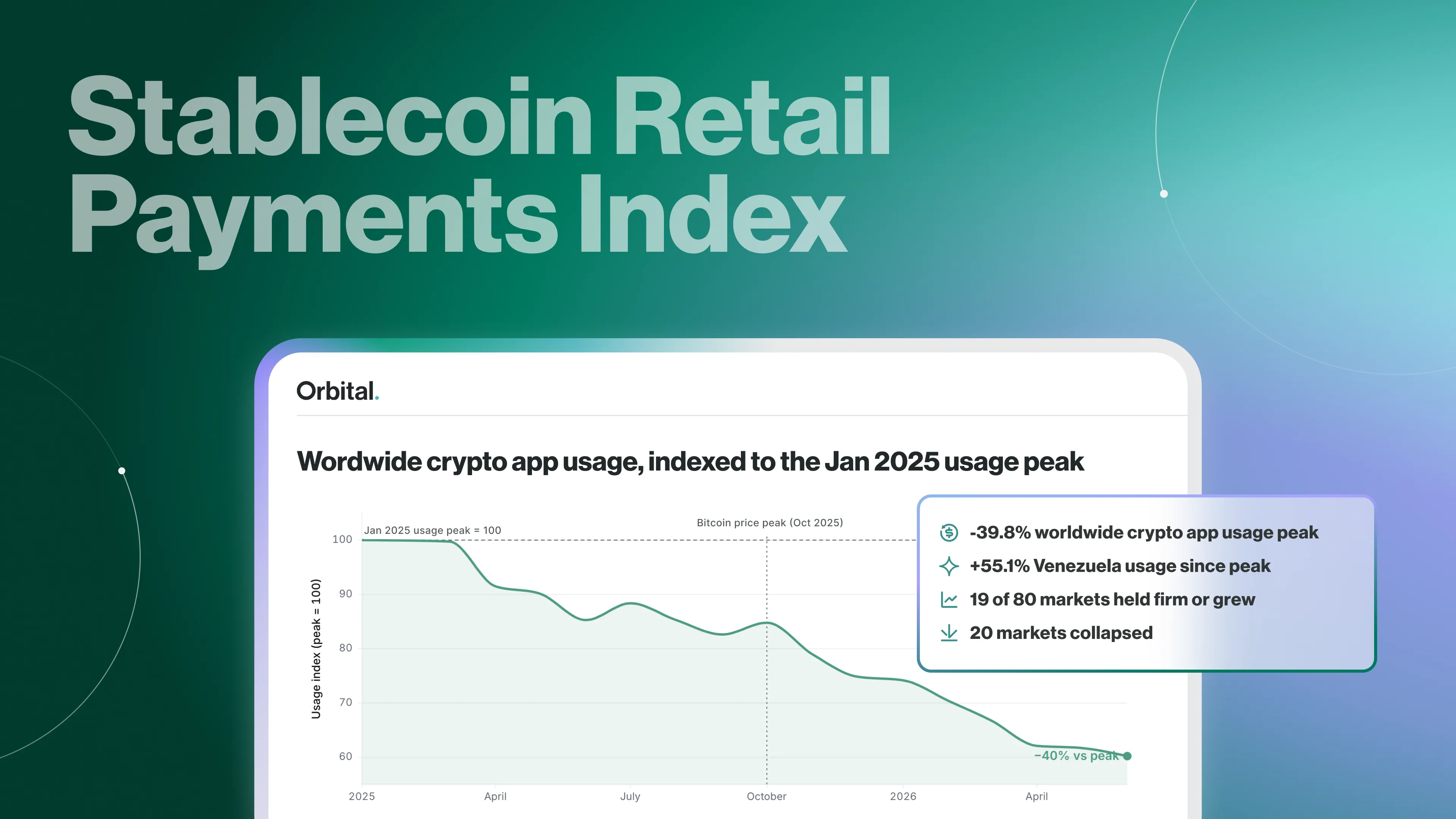
The Index finds that the 2026 crypto “winter” has become the clearest test as to where digital assets provide genuine utility. While global crypto app usage fell almost 40% from January 2025 to June 2026, one in four markets either retained the same number of users or grew, suggesting demand for stablecoins is increasingly driven by practical financial need rather than speculation.
The markets that proved the most resilient were not necessarily those with the highest rates of inflation. Instead, they were typically those where consumers face unstable currencies, limited access to US dollars or gaps in the traditional financial system. In these markets, stablecoins are increasingly being used as payment infrastructure to solve “broken” currencies.
Key findings include:
Crypto usage peaked before the price peak
Crypto app monthly active users peaked in January 2025 and declined steadily from there. By the time Bitcoin reached its October 2025 all-time high, app usage had already fallen about 15% from the January peak, showing that consumer attention rolled over before the market price did.
A small group of markets held up or grew
19 of the 80 markets analysed either held up or grew across the period. Venezuela recorded 55.1% usage growth and now has one of the world’s highest crypto app penetration rates at 21.3% of the internet-enabled population. Angola nearly doubled its user base. These markets are concentrated in economies where crypto is used to hold and move dollars, or where the local financial system does not fully meet consumer needs.
Speculation left, utility stayed
At the other end of the table, the steepest declines came in markets that had been most exposed to speculative retail activity. Nigeria fell 59.6%, Brazil 53.6%, the United States 50.9%, Türkiye 49.6%, the United Kingdom 48.6% and Pakistan 46.5%, underscoring the split between hype-driven usage and utility-led adoption.
A broken-money story, not an inflation story
The data suggests that headline inflation alone is not a good predictor of stablecoin use does not explain adoption. While some high-inflation markets held up, while some lower-inflation markets also grew, pointing instead to currency instability and dollar access as the more important drivers. In many of these markets, stablecoins increasingly function as a practical financial rail rather than a speculative asset.
Stablecoin utility comes in to sharp focus
The bear market has highlighted a clear divide between speculative crypto activity and stablecoin utility. In markets where digital dollars solve a real problem, such as currency instability, limited banking access, or difficulty accessing USD, stablecoin usage is proving far more durable.
“Rather than killing crypto usage outright, the bear market has cleared out the hype and left behind the parts people actually use,” said Luke Wingfield Digby, Co-Founder of Orbital. “Orbital’s analysis suggests this base of utility is likely to serve as the floor for the next cycle, with speculative demand building on top of it later.”
A link to the full H1 2026 Stablecoin Retail Payments Index, with more details of these and wider 2026 insights, can be found here.
-ENDS-
Important: The Stablecoin Retail Payments Index and Report is produced by Pay Perform Technologies Ltd. The views and information shared here are for general informational purposes only and do not constitute financial, investment, legal, or other professional advice. No representations or warranties are made as to the accuracy, reliability, completeness, or timeliness of the data or content provided. The analysis is based on publicly available blockchain and third-party data, subject to known limitations, assumptions, and estimation methods including but not limited as outlined in the Methodology & Limitations section. Readers should conduct their own due diligence and consult with a qualified advisor before making any financial decisions. Mentions of specific digital assets, protocols, or platforms are for analytical purposes only and do not constitute endorsements or evaluations of their quality, stability, legality, or regulatory status. Orbital does not recommend buying, selling, or holding any particular digital asset and makes no representations regarding the suitability of any such asset for any use.
Orbital is the trading name representing the Pay Perform group of traditional financial and digital asset service providers. Regulatory status of Orbital’s services differs per jurisdiction, and you may not be protected by government or regulatory protection schemes. Please see Legal Disclosures for more information or reach out to us at: hello@getorbital.com.
About Orbital group
Orbital group is an award-winning global payment orchestration platform specialised in delivering secure, seamless and compliant stablecoin and traditional payments for enterprises. It equips B2B and B2C businesses with an all-in-one platform that offers named vIBANs, stablecoin wallets, and the ability to pay-in, payout, and exchange across all major stablecoins, traditional currencies, and over 80 exotic currencies interchangeably.
Founded in 2017, Orbital is the trading name representing the group of traditional financial and digital asset service providers: Pay Perform Limited - a Financial Conduct Authority authorised payment institution, Pay Perform (Gibraltar) Limited - an e-money issuer permissioned by the Gibraltar Financial Services Commission, Pay Perform Digital Limited a distributed ledger technology provider authorised by the Gibraltar Financial Services Commission, Pay Perform OÜ a virtual currency service provider authorised by Republic of Estonia Financial Intelligence Unit and Pay Perform Switzerland GmbH a member of VQF SRO, an officially recognised self-regulatory organisation (SRO) according to the Swiss Anti-Money Laundering Act.
Orbital’s multi-jurisdictional licensing framework, combined with compliance with international security standards including SOC 2 Type 2, ISO 27001:2022, CSA TPC, and Cyber Essentials Plus, enables the platform to seamlessly unify both stablecoin and traditional currency payments on a global scale.
Methodology & Limitations
Retail payments activity is based on publicly available blockchain transaction data provided by Artemis. The methodology applies filters designed to isolate smaller, wallet to wallet transfers under US$10,000 as a proxy for retail or consumer scale payments. The analysis does not capture off chain transactions, private transfers or activity within custodial platforms, and should therefore be considered directional rather than comprehensive.
Consumer adoption is based on Sensor Tower data measuring monthly active users of leading cryptocurrency applications across 80 markets. To enable comparisons between countries of different sizes, crypto app users are indexed against messaging app users, which are used as a proxy for the internet enabled population. This provides a normalised measure of crypto app adoption over time.
The Index combines these datasets to examine both the scale of retail stablecoin activity and broader patterns of consumer adoption across global markets
Related articles
.avif)
.webp)





.avif)