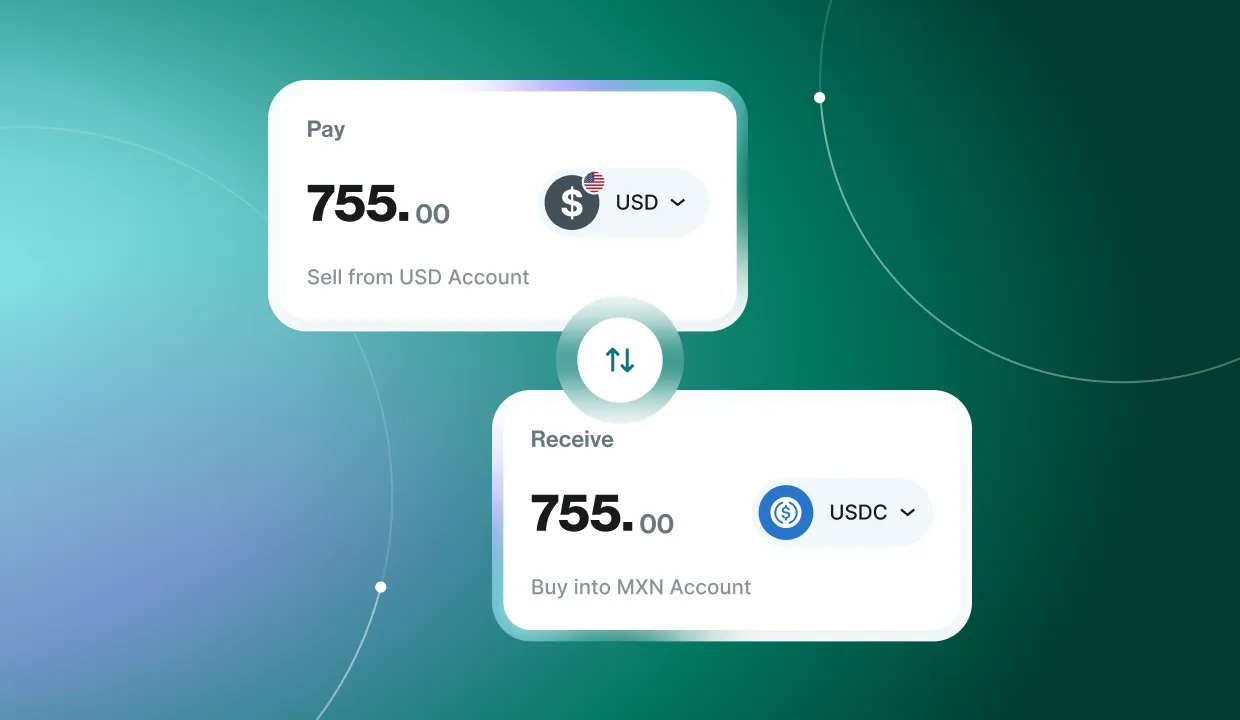





A two-way quote for USDT against the US dollar, taken apart. All prices in this article are illustrative.
Ask ten people in payments what a spread is and you’ll get ten answers. Most of them describe something else.
The most common mix-up is calling distance from par a spread. A stablecoin prints at 0.9998 against the dollar and someone says the spread is 2 basis points. Blend those two ideas and you misjudge which provider is cheap, chase the wrong complaint and pay more than you need to every time you move money.
So let’s take a quote apart, one number at a time.
One price is not a quote
Here’s a sentence you’ll hear on a desk, or read in a client email: “USDT is at 0.9998, so the spread is 2 bps.”
The 2 bps is real. It just isn’t a spread. It’s the distance from par: how far one price sits from the dollar the coin is designed to track. One price, measured against one peg.
A price you can actually trade on comes in pairs. The bid is what a provider will pay you for each coin. The ask, also called the offer, is what they’ll charge you for one. The ask is always the higher of the two.
Which one is yours depends on direction. Sell USDT for dollars and you get the bid. Buy USDT with dollars and you pay the ask. A broker converting a million USDT of client deposits receives $999,500. A business buying a million USDT to fund payouts pays $1,000,100, a little over a dollar a coin, even though the coin trades below par.
Halfway between the two sits the mid, 0.9998. You can’t trade at the mid on this quote. It’s a reference point, and it’s the number to hold up against par: this coin is trading 2 bps under the dollar, whoever is quoting it.
The spread is the width between bid and ask: 1.0001 minus 0.9995, or 6 bps. It describes the quote, not the coin. You could see the same 6 bps with the coin at par, or at 0.95.
On any single trade you only cross half of it. Buy at the ask and you’ve paid 3 bps over the mid. Sell straight back at the bid and you give up the other 3. The full spread is the cost of a round trip.
So that first sentence folded two measurements into one. Our broker sold at 0.9995, 5 bps under the dollar. Two of those are the coin trading below par. Three are the cost of crossing the spread, and only those three have anything to do with who quoted the price.
Two dials, not one
Distance from par and spread move independently, which is easier to show than to describe. Drag the dials below. The first moves the market price of the coin. The second widens or narrows the quote around it. Neither drags the other along.
- Distance from par
- 2 bps below
- Spread
- 6 bps
- You’d sell at
- 0.9995
- You’d buy at
- 1.0001
Distance from par is measured from the mid to the peg. The spread is measured between bid and ask. One dial moves the coin, the other widens the quote.
The first dial belongs to the market. At any moment every provider is looking at roughly the same coin price. The second belongs to whoever is quoting you, and it’s where providers compete. When a stablecoin slips 10 bps below par, that isn’t your provider’s doing. When the gap between their bid and ask widens, it is.
Five quotes, one moment
Here’s where it gets practical. You need to move a million dollars’ worth of USDT, and five providers send you a two-way price at the same instant. The market mid at that moment is 0.9998, two basis points under par.
Before reading on, pick the one you’d trade with.
The price you’d actually get, fees included, ranked best to worst
Buying, the best price comes from C at 0.9999, a quote with a 12 bps spread. B quotes a third of that spread and still charges more, 1.0000. E, which showed no spread at all, finishes last once its fee is added.
Five illustrative two-way quotes, received at the same moment. Real quotes widen as tickets grow; here they’re held constant so the comparison stays clean.
Two things are going on. The best provider flips with direction, so a headline rate tells you very little unless it says which side it’s for. And the tightest spread on the screen isn’t necessarily the best price, because spread width is only one of the places a price is made.
Where the margin hides
Every quote above breaks down into the same three parts. How wide it is: the spread, half of which you pay on any one trade. Where it sits: how far the provider has moved its own mid away from the market’s, which traders call skew. And what’s added on top: fees.
Half the spreadSkewFeesYour cost
Cost against the market mid, in basis points. Skew adds to your cost when a quote leans against your direction, and takes it away when it leans with you.
C and D aren’t being generous or greedy. Skew is how dealers manage inventory. A provider holding more USDT than it wants shades its whole price down to attract buyers, and one that’s short does the opposite. In a two-way price, whatever skew gives one side it takes from the other.
It becomes a hiding place when you only see one side. Ask for a price to buy and you might be told 1.0003, no fees, tight spreads. If the market mid is 0.9998, you’re paying 5 bps, whatever spread sits on their screen.
“Tight spreads, no fees.”
A one-sided quote. The spread behind it can be genuinely tight while the price you’re given sits well away from the market.
The one measure that can’t be dressed up is the distance between the side you trade and the market mid. Which raises the obvious question: where does the market mid come from?
The number on your second screen
Most people check a quote against XE, Bloomberg, Reuters, Yahoo Finance or CoinMarketCap. Each publishes a number. None of those numbers is a price anyone will deal on, and they’re built in two quite different ways.
A mid of many mids
Traditional FX references such as XE, Bloomberg and Reuters publish a mid-market rate: the midpoint of the buy and sell prices dealers quote in the wholesale market. XE says plainly that the rate on its converter is for information only, and that not even XE can buy currency at it.
An average of what already traded
Crypto aggregators work differently. CoinMarketCap takes the latest prices from many exchanges and weights each one by how much that market trades. Yahoo Finance’s crypto pages show CoinMarketCap’s data, so the two aren’t independent checks on each other.
Illustrative inputs. In the second panel, each circle sits at a venue’s latest price, and circle size and line weight show how much it trades.
One kind of benchmark is a midpoint of prices on offer. The other is closer to an average of trades that have already happened. Both are estimates of the market mid, and neither is a firm, executable price from a specific provider at a specific moment. If you’re converting stablecoins into euros or sterling, part of your price is a traditional FX rate, which is where the first kind comes in.
That’s why holding a provider’s ask up against a benchmark and calling the whole gap a mark-up is only half right. Some of that gap is your real cost of trading, and it’s exactly what you should measure. But the comparison only works if the benchmark describes the same moment, the same instrument and a fair estimate of the mid. A rate that’s a few minutes old, or a dollar to euro rate held up against a USDT to euro conversion while USDT trades below par, will make a fair quote look wrong.
Treat the benchmark as your best guess at the mid, check its timestamp, and expect to pay something over it. Then ask how far the side you trade sits from it.
What the exchange screen is showing you
Asks above, bids below. Bars show how much is resting at each price.
One more comparison comes up constantly: a client watching a price tick on an exchange and holding it up against a quote.
The big number at the top of an exchange screen is usually the last traded price. It tells you where the most recent buyer and seller met.
That makes it a record of the past. By the time you read it, the trade is done and the market may have moved. The last print here was 0.9995, but the best bid is now 0.9997 and the best ask 0.9998. You can’t buy at 0.9995 any more, and a seller would now get more than that.
Behind the ticker sits the order book: every resting bid and ask, and how much is available at each price. It has its own spread, just 1 bp here, and it changes every time an order is placed or pulled.
Size matters too. The best ask is good for just 250,000 USDT. Buy more and you work up the book, paying a little more at each level.
- Average price
- 0.99989
- Against the book mid
- +1.4 bps
- Against the last price
- +3.9 bps
So “the exchange showed 0.9995 and you quoted me 1.0001” compares a finished trade with a live, firm price for a full ticket. The ticker leaves out the exchange’s own fees, too.
The anatomy, labelled
Keep this for the next time a quote lands in your inbox.
- Par
- The value a stablecoin is designed to hold, usually one dollar. A target, not a price.
- Bid
- What a provider will pay you per coin. You receive it when you sell.
- Ask, or offer
- What a provider charges you per coin. You pay it when you buy. Always above the bid.
- Mid
- Halfway between the bid and the ask. A reference point, not a price on offer.
- Spread
- The width between the bid and the ask. It describes the quote, not the coin.
- Half-spread
- What you give up against the mid on a single trade, before skew and fees.
- Distance from par
- How far the market mid sits from par. A fact about the coin that every provider faces.
- Skew
- How far a provider’s mid sits from the market’s. It helps one direction and costs the other.
- Fees and all-in price
- Anything charged on top of the quoted rate. Add it in, then rank providers on the all-in price.
- Benchmark
- A published reference rate from a source such as XE or CoinMarketCap. An estimate of the mid, not a price anyone will deal on.
- Last price
- The price of the most recent trade on an exchange. Accurate about the past, silent about now.
- Firm quote
- A price a provider will honour for a stated size and a short, stated window. Benchmarks and tickers are neither.
Five questions for any quote
- Which side am I on? Selling means the bid. Buying means the ask.
- Where is the market mid right now? Know where that number comes from, and how old it is.
- How far does my side sit from that mid? That gap, in basis points, is your cost of trading.
- Are there fees on top? Add them in before comparing anything.
- Is the price firm? For your full size, and for how long?
Get the vocabulary straight and most arguments about price resolve themselves. A tight spread around a fair mid, with nothing extra on top, is what good execution looks like. Anything else is the same cost, moved somewhere harder to see.
Orbital takes this work off your hands. As a regulated payments platform combining fiat accounts with stablecoin rails, we source liquidity from multiple providers and give you the best available price for your size and direction, so you don’t have to take every quote apart yourself.
Frequently asked questions
What is the spread on a stablecoin quote?
The spread is the difference between the bid and the ask. On a quote of 0.9995 bid and 1.0001 ask, the spread is 0.0006, or 6 basis points. It describes how wide the provider’s quote is, not where the coin is trading, and on any single trade you pay roughly half of it against the mid.
Is distance from par the same as a spread?
No. Distance from par measures how far a stablecoin’s mid price sits from its peg, usually one US dollar. A coin with a mid of 0.9998 is 2 basis points below par. The spread is the gap between the bid and the ask. The two are independent: a coin can trade well away from par with a tight spread, or at par with a wide one.
What does it mean when a stablecoin trades below par?
It means the market mid is below the value the coin is designed to hold. If USDT’s mid is 0.9998, sellers receive a little under a dollar per coin, while buyers can still pay a little over a dollar, because the ask often sits just above par. The discount belongs to the market at that moment and applies to every provider, so on its own it says nothing about what a particular provider charges.
How do I compare stablecoin quotes from different providers?
Compare the price you would actually get on the side you are trading. Use the bid if you are selling and the ask if you are buying, add any fees, then measure how far that price sits from the market mid at the same moment. The provider with the smallest gap is the cheapest, whatever its headline spread.
Can a quote with no spread be more expensive?
Yes. The spread is only one of the places a price is made. A provider can quote the same bid and ask and charge a percentage fee instead, or shift its whole quote away from the market mid. In the example above, a zero-spread quote with a 0.10% fee was the most expensive way to buy.
What is skew in a stablecoin quote?
Skew is how far a provider has moved the centre of its quote away from the market mid. Dealers skew their prices to manage inventory. Skew makes one direction cheaper and the other more expensive, which is why the best provider for buying is often not the best for selling.
Can I trade at the rate shown on XE or CoinMarketCap?
No. Benchmarks such as XE, Bloomberg, Reuters and CoinMarketCap publish an estimate of the market mid for information. XE states that the rate on its converter is not available to customers. Use a benchmark as a reference for the mid, check its timestamp, and expect a firm quote to sit somewhat away from it.
Why is an exchange’s last price different from the quote I received?
The last price is the most recent trade on the exchange, so it describes the past. A quote is a live, firm price for your full size now. A large order would also work through several levels of the order book, so its average price is usually worse than the price at the top of the book.