



A closer look at the factors shaping stablecoin FX costs, from conversion rates and fees to settlement timing and the final amount received.
Lower costs are one of the strongest arguments for using stablecoins in cross-border payments. But understanding the true cost means looking beyond network fees. A stablecoin route between two currencies typically involves two conversions, each with its own price, plus a network fee that's easy to see but tells you little about the total. Comparing providers means knowing what sits inside each of those numbers.
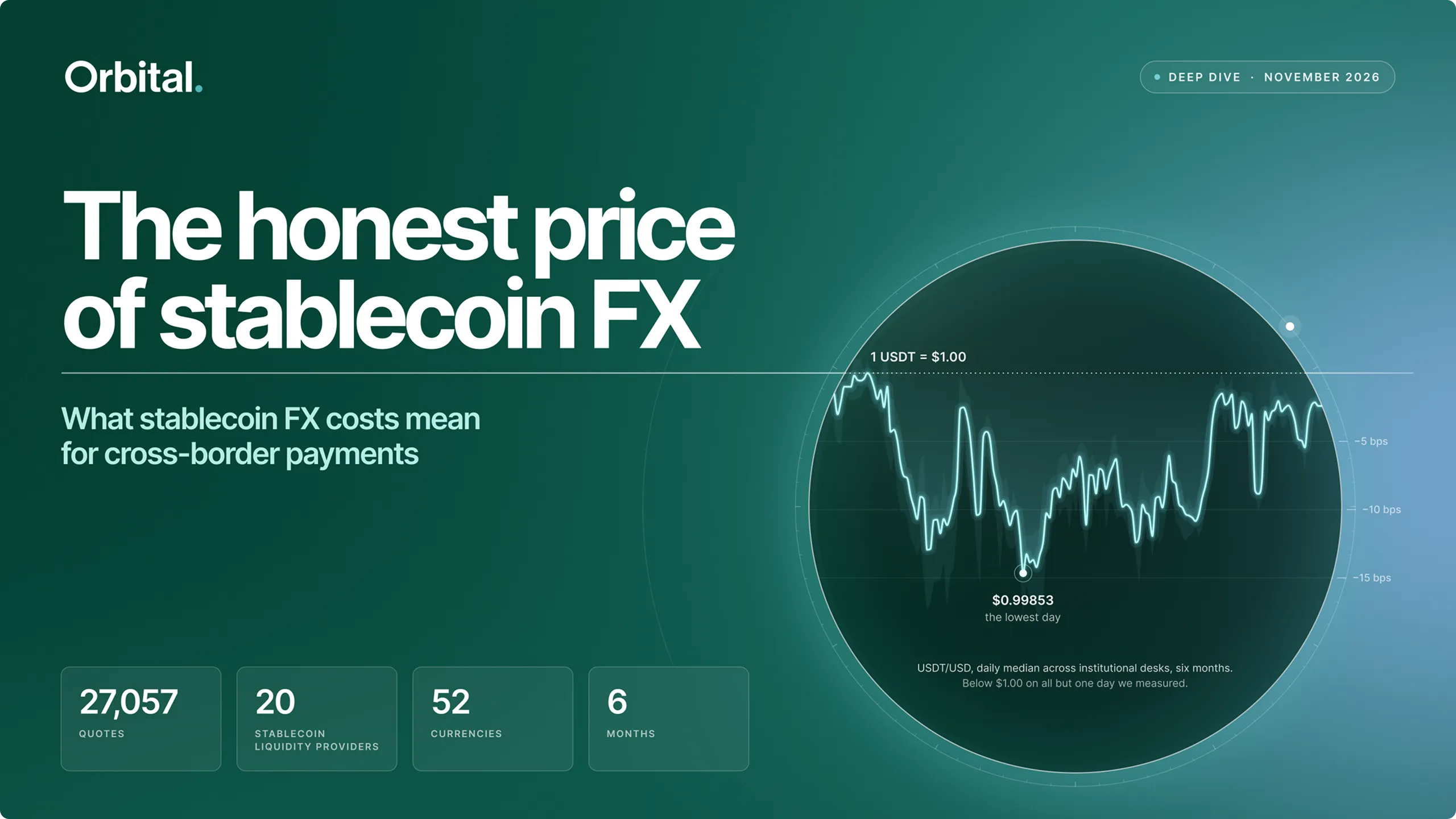
We set out to measure that cost. Between April and October 2026 Orbital Research collected more than 27,000 indicative USDT quotes from 20 stablecoin liquidity providers across 52 currencies, then compared stablecoin routes with fintech and institutional FX pricing, corridor by corridor and in both directions. The report, The honest price of stablecoin FX, publishes the results alongside the methodology and its limits.
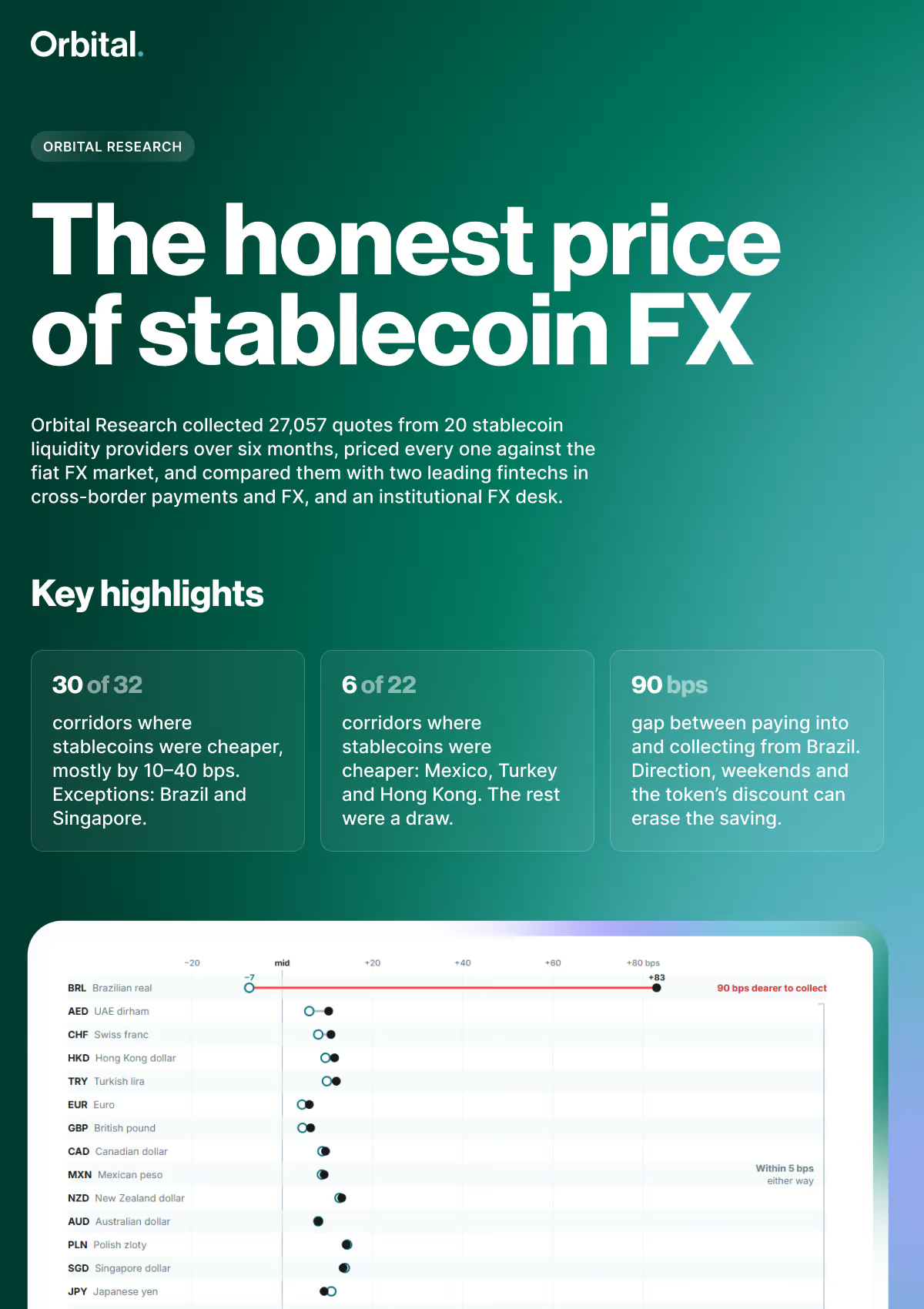
Compare stablecoin routes based on the final amount your recipient receives. Conversion costs and the direction of the payment can affect the price. In Orbital Research's sample, USDT beat the cheaper of two leading fintechs in 30 of 32 tested corridors, and won 6 of 22 comparisons against an institutional FX desk, drawing the other 16. Whether that holds for your payment depends on your current route and a firm quote.
Where the cost sits in a stablecoin payment
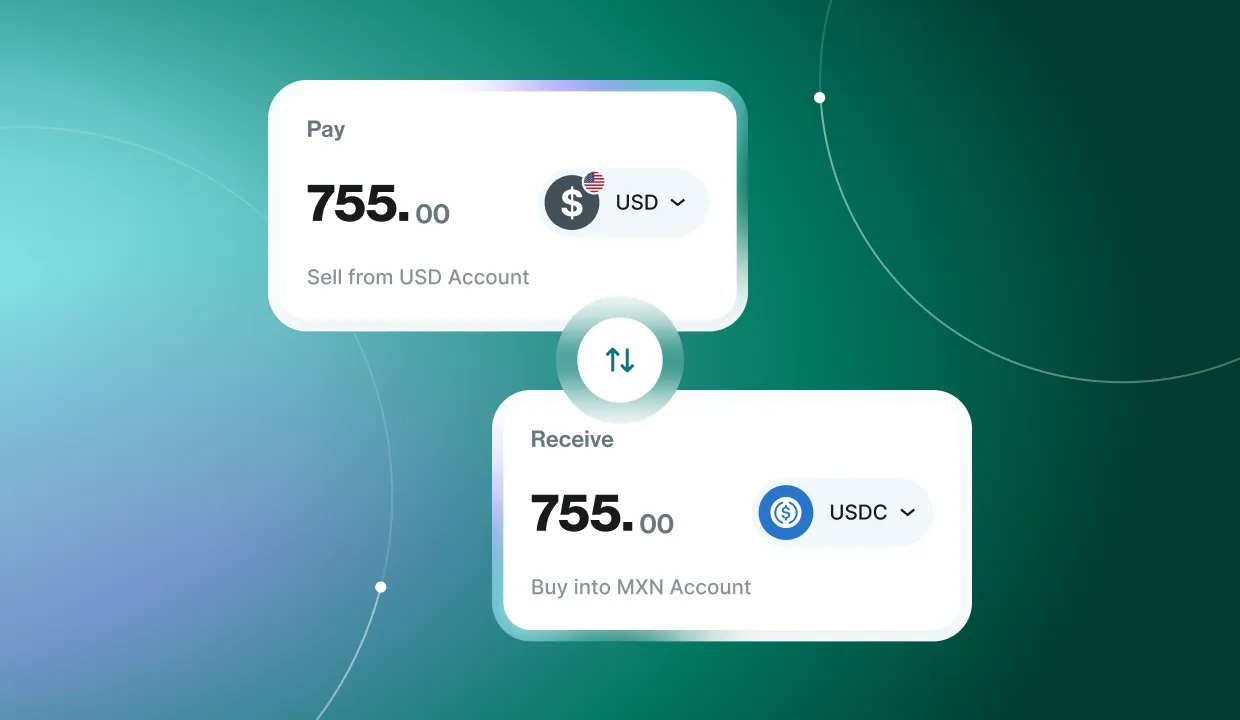
A stablecoin payment between two fiat currencies typically involves two trades. Dollars buy USDT, the USDT moves, and the USDT is converted into the recipient's currency at the other end.
We discussed this 'stablecoin sandwich' in Following the Data.
Each layer has its own costs, and only one of them is the network. If you already hold USDT, you may not need the initial conversion. If your supplier accepts USDT, the final conversion may not be necessary either.
Here's an illustrative breakdown of the cost involved in sending $100,000 to a supplier in Singapore. Costs are shown in basis points (bps). One basis point is 0.01%.
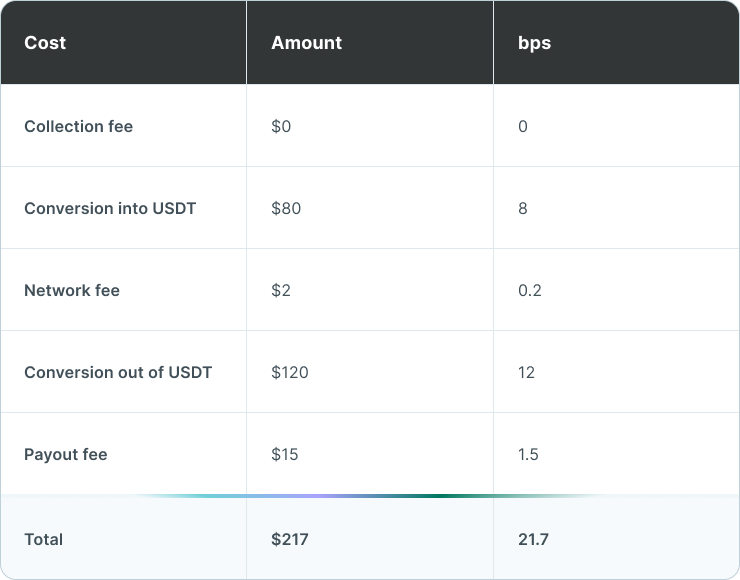
Illustrative example only, not actual provider pricing or a finding from the research. The example assumes separate, non-overlapping costs. In practice, charges may be bundled into a quoted exchange rate or payment fee.
In this example, the network fee comes to just $2. The two conversions either side of it come to $200. Focusing only on the network fee could leave a business overlooking another $215 in costs. Unless these are accounted for upfront, the supplier may receive less than expected, creating reconciliation issues.
For treasury teams managing recurring supplier payments, these differences matter. They affect the effective cost of each payment, the amount that needs to be funded and potentially the amount received by the supplier.
The objective is to understand the full cost before committing to a payment, rather than discovering additional charges during settlement or reconciliation.
Is a stablecoin payment cheaper? What the research found
The answer depends largely on the FX rates your business already receives. A company using a fintech provider may see a different cost advantage from one with access to institutional FX pricing.
The corridor figures rest on eight of the providers in the research, with indicative institutional quotes collected four times a day, seven days a week. Cost is measured as the distance from the XE mid-market rate across both conversions, and network fees aren't included. These are indicative quotes, not executed trades, and the report notes that actual execution may be more expensive.
Between 29 July and 6 October 2026, the USDT route beat the cheaper of two leading fintechs in 30 of 32 tested corridor-direction comparisons. One was a draw. In the remaining comparison, collecting from Brazil, the fintech was cheaper by 24 bps.
Against an institutional FX desk, sampled for three weeks in August, USDT was cheaper in 6 of 22 comparisons, with the remaining 16 within a 5 bps margin.
For a business already holding USDT, paying out cost 10 to 21 bps more than collecting in 15 of 17 currencies. In the report's words, "A corridor isn't cheap or expensive. A direction is."
The potential savings therefore depend on how a business currently manages its FX payments. Businesses using fintech providers may find opportunities to reduce costs, while those already accessing institutional FX rates may see little additional benefit.
For CFOs and treasury teams, the implication is straightforward: stablecoin FX should be assessed against existing banking and payment arrangements, not against a generic market benchmark alone.
Even where a route offers lower FX costs, that advantage needs to be considered alongside settlement requirements, liquidity availability and the operational processes involved in making the payment.
How to compare stablecoin routes on your own payment
Getting a firm quote, and understanding what it includes, is the practical part.
Two quotes are comparable only when they price the same amount, currency pair, direction and point in time. A benchmark rate provides a useful reference point, but a firm quote shows the price actually available for a specific transaction.
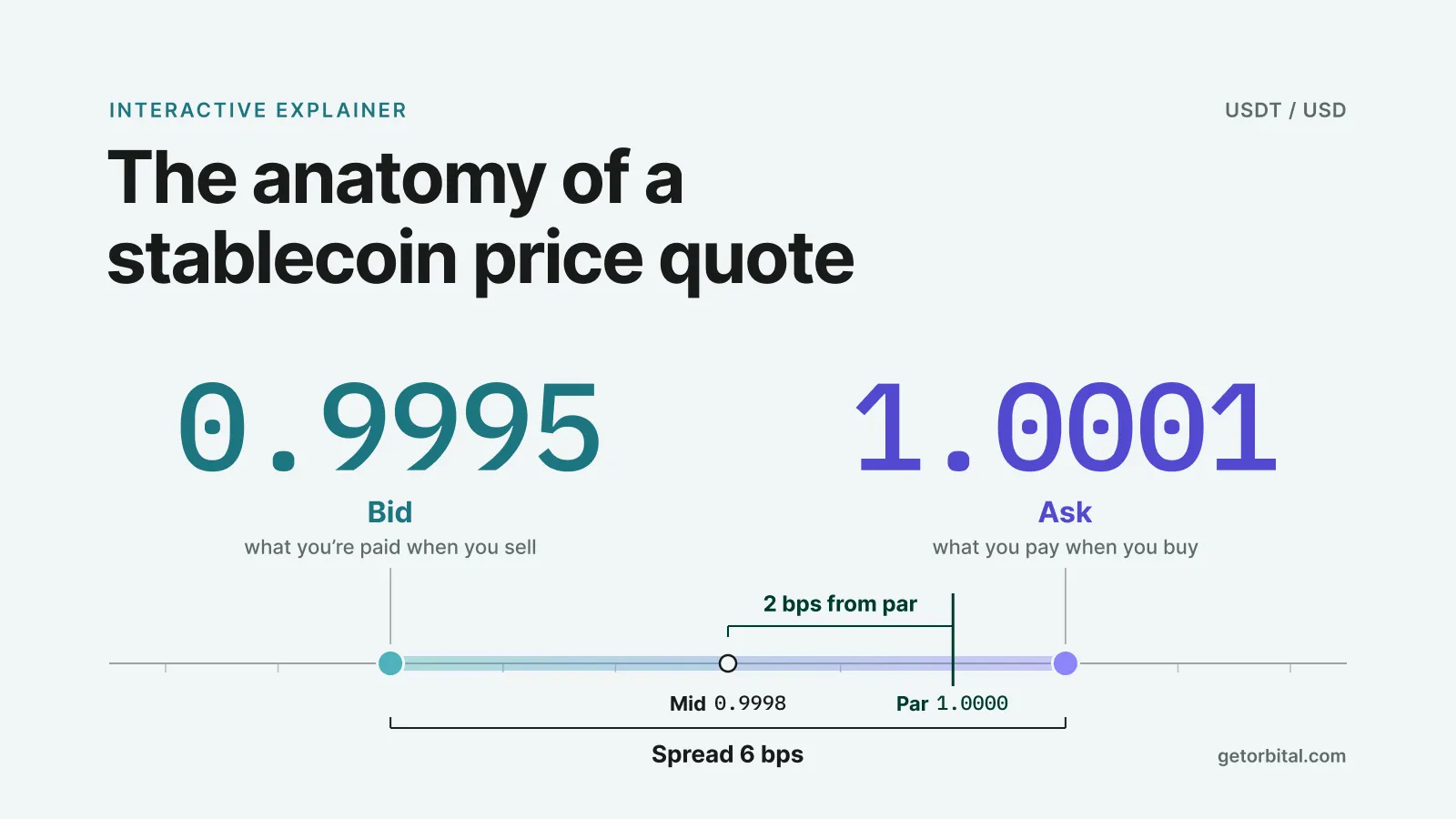
Comparing like-for-like quotes gives businesses a clearer picture of the actual costs. We take a single quote apart (bid, ask and skew included) in The Anatomy of a Stablecoin Price Quote.
Orbital's research found that at weekends, some stablecoin liquidity providers more than doubled their margin or stopped quoting altogether, despite stablecoins operating around the clock.
For treasury teams managing payments across different markets and time zones, this distinction is important. The ability to transfer stablecoins 24/7 does not necessarily mean the same FX pricing or liquidity will be available at all times.
For the payment as a whole, put these questions to every provider:
- How much does the recipient need to receive? Work back from the supplier's account, since that's the number the invoice cares about. Confirm whether fees are deducted from the payment or charged separately to the sender.
- Are you collecting funds or making a payout? The research shows direction moves the price, so get quotes for the direction you actually need.
- How many conversions are involved, and when do they take place? A firm price on the first trade doesn't necessarily guarantee the price of the second. Ask whether the rate is locked and for how long.
- What's included in the total? Get conversion, collection, network and payout charges in writing, totalled in the recipient's currency. Compare the total against the cost of your existing payment route.
- What conditions must be met before settlement? Settlement, reconciliation and eligibility requirements can determine whether a route is suitable, regardless of the price. Consider whether the payment process fits your existing treasury and accounts payable workflows.
It's also worth evaluating the impact across your payment volumes, rather than looking at a single transaction in isolation.
Small differences in FX costs can quickly add up. On $100,000, the difference between 20 and 35 bps is $150 per payment. Across 100 equivalent payments, that's $15,000 in potential cost difference.
These are illustrative calculations, not quotes, and any additional charges would affect the final cost.
For businesses managing significant cross-border payment volumes, benchmarking the cost of existing routes against alternatives can reveal where savings may be available, even if stablecoins aren't the most competitive option in every corridor.
What this means for your next payment
Understanding the full cost of a stablecoin payment starts with the conversions. Businesses should compare both legs of the transaction, account for the direction of payment and assess each route based on the final amount received.
The research found that where stablecoins win, they can cost meaningfully less in specific payment directions. Where they don't, comparing firm quotes can help businesses identify a more competitive route before moving any money.
For CFOs and treasury teams, the decision ultimately comes down to three considerations: the total cost relative to existing providers, the certainty of the amount received and whether the payment route meets the business's operational requirements.
The full research report provides detailed findings, methodology and limitations.
Want to understand how your existing cross-border payment costs compare?
Frequently asked questions
Research source:
Orbital Research, The Honest Price of Stablecoin FX (October 2026). The report covers indicative USDT quotes collected between 28 April and 6 October 2026. Its FX comparisons exclude network fees and are not representations of executed transaction pricing. Payment services are subject to applicable eligibility and compliance requirements.
Notes
Quote dataset: quote count, currency coverage, the 28 April to 6 October 2026 window, USDT, the eight desks and their polling schedule are from Orbital Research, The honest price of stablecoin FX (October 2026), methodology. The same source gives the cost measure (distance from the XE mid-market rate) and the exclusion of network fees.
Comparisons and quotations: the fiat comparison window, corridor results, the August institutional sample, the direction finding, the weekend pricing finding, and the lines on corridors and winning margins come from the same report.
Illustrative figures: the cost table and the 20 versus 35 bps comparison are illustrative arithmetic, not executable quotes. A basis point is a hundredth of a percent.
Important: The views and information shared here are for general informational purposes only and do not constitute financial, investment, legal, or other professional advice. No representations or warranties are made as to the accuracy, reliability, completeness, or timeliness of the data or content provided. The analysis is based on publicly available blockchain and third-party data, subject to known limitations, assumptions, and estimation methods including but not limited as outlined in the Methodology & Limitations section. Readers should conduct their own due diligence and consult with a qualified advisor before making any financial decisions. Mentions of specific digital assets, protocols, or platforms are for analytical purposes only and do not constitute endorsements or evaluations of their quality, stability, legality, or regulatory status. Orbital does not recommend buying, selling, or holding any particular digital asset and makes no representations regarding the suitability of any such asset for any use.
Methodology & Limitations: This Index is based on analysis of public blockchain transaction data. Our methodology includes filters designed to isolate smaller, wallet-to-wallet transfers under $10,000, which we use as a proxy for “retail” or consumer-scale payments. This threshold is an analytical assumption; while it helps remove larger institutional or speculative trades, it does not guarantee that all included transactions are truly consumer payments. Similarly, wallet activity is inferred using best-effort heuristics, which may result in some misclassification. Blockchain data is inherently pseudonymous and incomplete. This report does not capture off-chain transactions or private transfers, and should be considered directional rather than comprehensive.
Related articles