


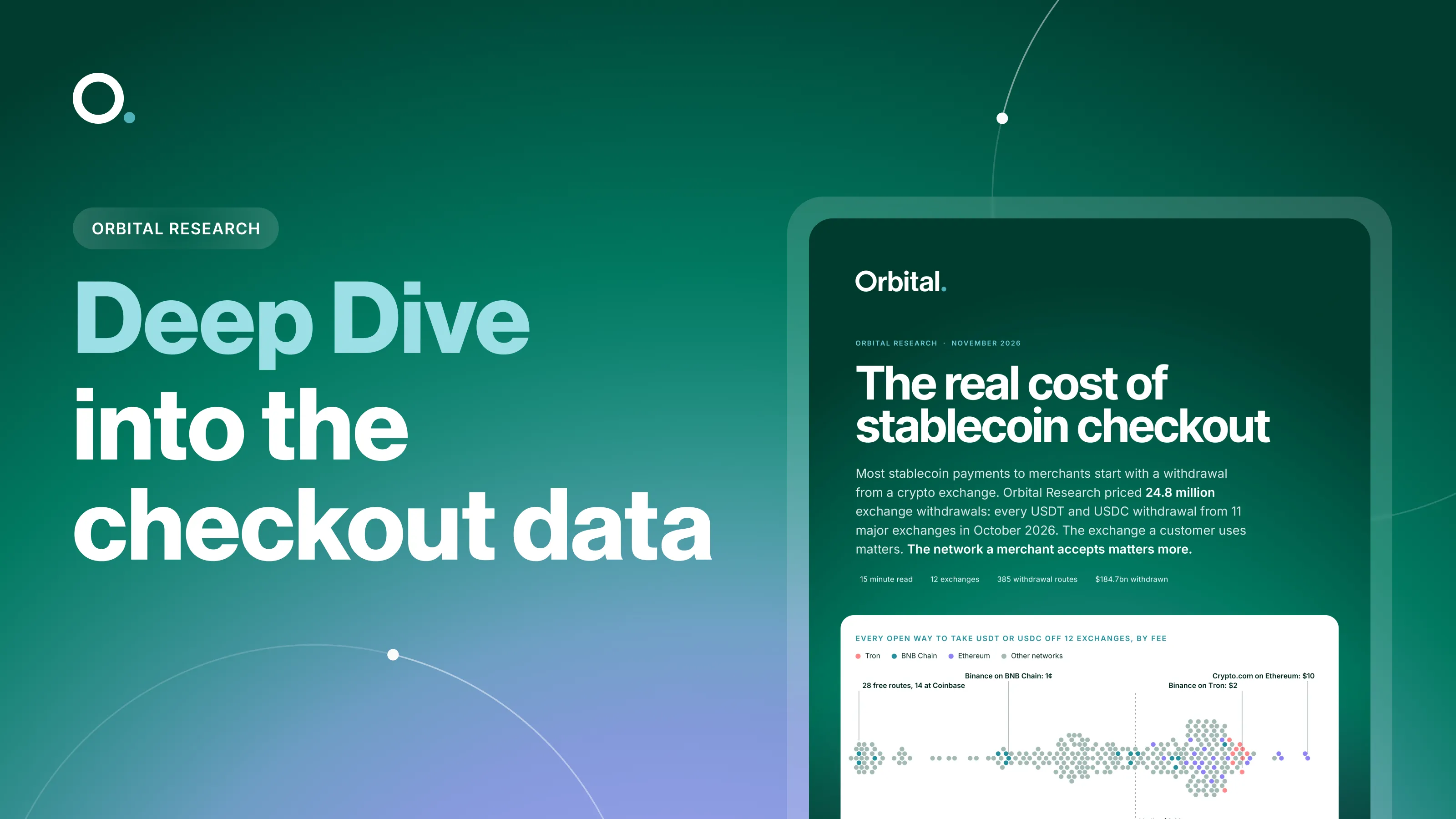


Your checkout says $20. For a customer paying in USDT* from a crypto exchange, sending that hypothetical $20 could cost $21.50 on Tron or $20.01 on BNB Chain. That’s what the median withdrawal fees on 3 November 2026 would have meant for the same order: 7.5% of the order value on Tron and 0.05% on BNB Chain.
These fees matter because of where customers keep their stablecoins. Between August and October 2026, around 70% of the stablecoin payments processed by Orbital for merchants came directly from crypto exchanges. The exchange sets the withdrawal fee for each stablecoin and network. The networks you accept determine which of those options your customers can use.
*USDT is not supported by Orbital’s EU-regulated service providers servicing EU customers.
Where the withdrawal fees went
In October 2026, users of the 11 major cryptocurrency exchanges we studied withdrew $184.7 billion in USDT* and USDC. The sample covers exchange withdrawals of all kinds, not only payments to merchants. We estimated total fees of $17.3 million by applying the fee schedules from 3 November to October’s withdrawals, using Binance’s October rate for USDT* on Tron.
Tron and BNB Chain carried similar shares of those withdrawals. Tron handled 39% of withdrawals and accounted for 83% of estimated fees, or about $14.4 million. BNB Chain handled 37% of withdrawals and accounted for 2.6% of estimated fees.
We then modelled what would have happened if every customer had used the cheapest network their exchange offered for the same stablecoin. Estimated fees fell to about $340,000, a theoretical reduction of 98%. At checkout, that cheaper route is useful only if the customer’s exchange offers it and the merchant accepts it.
The fee reflects two decisions. The network determines what it costs the exchange to process the transfer. Sending USDT* on Tron, for example, uses a resource called energy. Exchanges can reduce that cost by staking TRX, Tron’s token, or renting energy. The exchange then sets what it charges the customer. That fee can exceed the cost of the transfer, and two exchanges can charge different amounts for sending the same stablecoin on the same network.
Withdrawal fees are one part of the cost. Customers may also pay to convert between currencies.
*USDT is not supported by Orbital’s EU-regulated service providers servicing EU customers.
Small orders can cost more to send or arrive short
About half of the withdrawals we analysed were under $100, and more than a third were under $50. A flat withdrawal fee takes up a larger share of a smaller order, which can give customers a reason to switch payment methods or leave the purchase unfinished.
Minimums can also stop a customer sending the order amount at all. Exchanges set minimum withdrawals by stablecoin and network. On 3 November, some exchanges had a 10 USDT* minimum on Tron, making that route unavailable for transfers below 10 USDT*.
How the exchange collects the fee matters too. Some routes carry no fee. On others, the exchange deducts the fee from the amount sent. If a customer enters the exact order total on one of those routes, the merchant receives less than the amount due.
*USDT is not supported by Orbital’s EU-regulated service providers servicing EU customers.
Fees change and withdrawal routes can pause
On 1 November, Binance raised its USDT* withdrawal fee on Tron from $1.50 to $4. By 16 November, it had cut the fee to $2.
Over a longer period, the changes went both ways. We compared 201 withdrawal routes between January and 3 November 2026, with each route defined by an exchange, a stablecoin and a network. Fees rose on 53 routes, fell on 59 and stayed the same on 89. Separately, 17% of all listed routes were paused on 3 November.
If your checkout accepts just one network for a stablecoin, customers paying from an exchange have no fallback for that stablecoin when their exchange pauses the route. A second network gives them somewhere to switch if their exchange supports it.
*USDT is not supported by Orbital’s EU-regulated service providers servicing EU customers.
“Merchants can’t control exchange withdrawal fees, but they can offer customers a choice of compatible and lower-cost networks,” said Luke Wingfield Digby, co-founder and Head of Corporate Development at Orbital. “Getting that right now could help make stablecoin checkout payments more affordable and easier to use as adoption grows, while reducing friction and potentially improving conversion.”
What to weigh up before a peak trading week
The right networks depend on the stablecoins your customers hold, the exchanges they use and what they typically spend. If Black Friday is one of your busiest weeks, these questions are worth answering before orders peak.
Your customers’ exchanges
For each stablecoin you accept, which networks do your customers’ main exchanges support for withdrawals?
The smallest orders
What would a customer pay in fees on those routes? Do any of the exchange minimums exceed the amount they need to send?
A fallback
If a low-cost route gets more expensive or pauses, is another compatible network available?
Network choices up front
Can customers see which networks you accept before they start a withdrawal?
Short payments
Is it clear how much needs to arrive? Will you accept small shortfalls or ask the customer to send the difference?
Fees and minimums over time
How often do you review them for the exchanges your customers use, especially before a busy trading period?
How Orbital helps merchants accept stablecoin payments
Orbital’s pay-ins let merchants collect payments in stablecoins and traditional currencies. Embedded payment pages bring stablecoin payments into your checkout through one API. You can also set payments to convert automatically into your preferred settlement fiat currency.
Orbital’s payment pages support USDT* on Tron, BNB Chain, Ethereum, Polygon and TON, and USDC on Ethereum, Solana, BNB Chain and Polygon. Availability depends on your jurisdiction. USDT* is not supported by Orbital’s EU-regulated service providers servicing EU customers.
Want to review the networks your checkout accepts against the exchanges your customers use?
*USDT is not supported by Orbital’s EU-regulated service providers servicing EU customers.
Important: The Real Cost of Stablecoin Checkout is produced by Pay Perform Technologies Ltd. The views and information shared here are for general informational purposes only and do not constitute financial, investment, legal, or other professional advice. No representations or warranties are made as to the accuracy, reliability, completeness, or timeliness of the data or content provided. The analysis is subject to known limitations, assumptions, and estimation methods including but not limited as outlined in the Methodology & Limitations section. Readers should conduct their own due diligence and consult with a qualified advisor before making any financial decisions. Mentions of specific digital assets, protocols, or platforms are for analytical purposes only and do not constitute endorsements or evaluations of their quality, stability, legality, or regulatory status. Orbital does not recommend buying, selling, or holding any particular digital asset and makes no representations regarding the suitability of any such asset for any use.
Methodology
Orbital analysed 24.8 million USDT* and USDC withdrawals from 11 exchanges in October 2026, estimating costs using fee schedules collected on 3 November, with Binance’s earlier Tron fee applied to October activity. These withdrawals were not exclusively merchant payments. The separate 70% finding comes from Orbital’s merchant transaction processing data for August to October 2026.
*USDT is not supported by Orbital’s EU-regulated service providers servicing EU customers.
Full methodology is available in the report.
Related articles